Popular Posts

Sunday, December 5, 2010

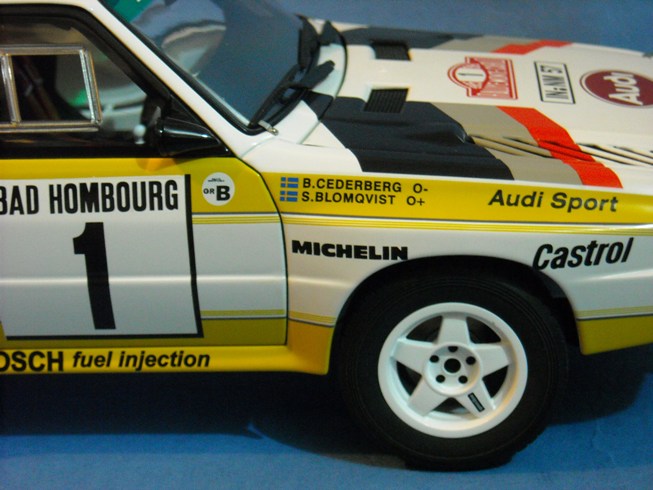
Autoart Millenium Audi Sport Quattro Rally de Monte Carlo 1985, S. Blomqvist / B. Cederberg in 1:18 scale

An Autoart Millenium Audi Sport Quattro, Rally de Monte Carlo 1985, driven by: S. Blomqvist/ B. Cederberg, in 1:18 scale.


From Wikipedia:
The Audi Quattro is a road and rally car, produced by the German automobile
manufacturer Audi, part of the Volkswagen Group. It was first shown at the 1980
Geneva Motor Show on 3 March.
The word quattro is derived from the Italian word for "four". The name has also
been used by Audi to refer to the quattro four-wheel drive system, or any
four-wheel drive version of an Audi model. To avoid confusion, the original
Quattro model is also commonly referred to as the Ur-Quattro - the "Ur-" (German
for "primordial" or "ancestral") is an augmentative prefix, in this case meaning
"original", and is also applied to the first generation Audi S4 and Audi S6
models, as in "Ur-S4" and "Ur-S6".
The Audi Quattro was the first rally car to take advantage of the then-recently
changed rules which allowed the use of four-wheel drive in competition racing.
It won competition after competition for the next two years.[1] To commemorate
the success of the original vehicle, all subsequent Audis with their trademark
quattro four wheel drive system were badged "quattro" with a lower case "q". The
original car with the upper case "Q" in the Quattro name is a collector's piece.
The Audi Quattro shared many components and the core of its body style with the
Audi Coupé, which was a member of the Audi 80 (B2) model range.[1] It was
internally designated Typ 85, a type number it shared with the Audi Coupé GT,
Audi Coupé quattro and Audi 4000CS quattro. Its characteristic flared
wheelarches were styled by Martin Smith. The Audi Quattro also had independent
rear suspension and independent front suspension.
The Quattro A1 debuted at the 1983 season opener Monte Carlo Rally, and went on
to win the Swedish Rally and the Rally Portugal in the hands of Hannu Mikkola.
Driven by Stig Blomqvist, Mikkola and Walter Röhrl, the A2 evolution won a total
of eight world rallies; three in 1983 and five in 1984.

Disney Store Red Chase, Cars, Radiator Springs

A Disney Store Red chase car, radiator springs, from the Disney movie Cars.  Red is 1960s style fire truck, which closely resembles a mid-1960s Pirsch pumper or American LaFrance model.  Joe Ranft played Red, who died in 2005 in a car crash.


Norev Volkswagen Iltis 1980 Dakar Rally, F. Kottulinsky / G. Loffelmann 1:43 scale VW

A Norev Volkswagen Iltis 1980 Dakar Rally, driven by: Freddy Kottulinsky/ Gerd Loffelmann in 1:43 scale.  Great looking Europa jeep.


From Wikipedia:
The Volkswagen Type 183, more commonly known as the Iltis (German for the
European Polecat), is a military vehicle built by Volkswagen for use by the
German military and under licence by Bombardier for the Canadian Forces and
Belgian Army. Although the two vehicles were briefly offered simultaneously, the
Type 183 effectively replaced the Type 181.
The German military had been part of a cooperative effort beginning in the late
1960s to create what was dubbed the Europa Jeep, an amphibious four wheel drive
vehicle that could replace the small all-terrain transport vehicles being used
by several of the participating governments. With development taking longer than
expected, the German military requested that something inexpensive be built in
small quantities to fill their need for additional small transport vehicles
while the Europa Jeep project was still undergoing design research.
Volkswagen responded to the request, designing an updated version of their
Kübelwagen and designating it the Type 181. But by 1976 the Europa Jeep project
had fallen apart completely, the victim of skyrocketing costs and a difficult
development. Needing a suitable four wheel drive vehicle to take over the spots
that had been designated for the Europa Jeep, the German government issued
requests to several manufacturers to design and build prototype vehicles to be
considered for military use.
Dakar Rally winner of 1980The vehicle featured a variation of the Munga's
platform with newly modified suspension components, a four wheel drive system
based around components from the Audi 100 and a 1.7 litre four cylinder Audi
engine producing 75 horsepower. The design of this four wheel drive system
provided the basis for Audi's Quattro system, which debuted four years later in
1980 on the original Audi Quattro. Earlier that year, Freddy Kottulinsky and
Gerd Löffelmann had won the Paris-Dakar Rally in an Audi-prepared Iltis.
The Iltis, as VW was now calling it, passed the German government's tests with
ease, and was chosen over the equally competent but more expensive Mercedes-Benz
G-Wagen. Production began in the summer of 1978 and the first 200 units were
delivered in November; by late 1979 approximately 2,000 units had been delivered
with 310 units sent to the Luftwaffe and 20 sent to the German Navy. Although
most of the units produced were four-doored with open tops, ambulance,
anti-tank, artillery survey, command and field communications units with varying
bodystyles were produced in small numbers. A civilian model was also offered in
Germany, but found even fewer takers than the 181 had, largely due to price.

Tuesday, November 30, 2010

Vitesse Ford Fairlane purple hog in 1:43 scale, driver: Curtis Turner

A Vitesse Ford Fairlane purple hog, in 1:43 scale, made in Portugal. The beauty of classic racing, driven by Curtis Turner.
  From the net:
   Curtis Turner was born in Floyd, Virginia and began his racing career in 1946 when he
finished 18th in a field of 18 contestants in a race at Mount Airy, North
Carolina. However, he rebounded and won his next race. During his career, he won
360 races in several different racing series, including 22 in the NASCAR
Convertible Division in 1956, and 17 wins in the NASCAR Grand National series
(now Sprint Cup). From 1950 to 1954, he drove for Oldsmobile being billed as the
Blond Blizzard of Virginia. He switched to driving Fords in 1954. He eventually
acquired the nickname of Pops, allegedly because of the way he would "pop" other
drivers on the track.


     Turner's 1967 Daytona 500 racecarCurtis Turner (April 12, 1924 – October 4,
1970) was an early NASCAR driver. In addition to his success in racing, he made
a fortune, lost it, and remade it buying and selling timberlands. Throughout his
life he developed a reputation for drinking and partying. In 1999, he was
inducted into the Virginia Sports Hall of Fame.
He is noted for several other racing accomplishments:
  The only NASCAR driver to win two Grand National races in a row from the pole
  by leading every lap (Rochester, New York and Charlotte, North Carolina in
  July 1950)
  The only win in NASCAR for Nash — Charlotte 150 — April 1, 1951
  The only driver to win 25 major NASCAR races in one season driving the same
  car in each of them (in 1956 — 22 were won as the #26 car in the convertible
  division, the other three, including the 1956 Southern 500, were with a top
  welded on.)
  The only driver to win a major NASCAR race that was red-flagged because his
  car was the only one still running (at the Asheville-Weaverville, North
  Carolina track on September 30, 1956.)
  The first driver to climb Pikes Peak in less than 15 minutes (in a 1962 Ralph
  Moody Ford — the actual time was 14 minutes 37 seconds for the 14 mile
  course.)
  The first winner of the American 500 at Rockingham, North Carolina (in a 1965
  Woods Brothers Ford.)
  The first driver to qualify for a NASCAR Grand National race at a speed
  greater than 180 miles per hour (1967 Daytona 500, driving #13, a 1967 Smokey
  Yunick Chevrolet.)
  Turner conceptualized, secured financing for, and built Charlotte Motor
  Speedway in 1960 before being forced out by his business partners.
  2006 inductee of the Motorsports Hall of Fame of America.
Being able to see the racing industry from the business end, he developed a
feeling that drivers deserved a better deal for their role in the sport. He
attempted to organize a union for them in 1961. Unfortunately for him, NASCAR
has never looked favorably on an organized union for the drivers, and Turner was
banned for life. However, the ban was lifted in 1965, and he returned to racing.

Monday, November 29, 2010

Bizarre GM Firebird III Motorama 1958 1:43 scale

This is Bizarre GM Firebird III Motorama 1958 in 1:43 scale, made of resin.


From the net:
   The General Motors Firebird is a series of three concept cars designed by Harley
Earl, and built by General Motors for the 1953, 1956 and 1959 Motorama auto
shows. They were very much inspired by innovations in fighter aircraft design at
the time. None of the designs were intended for production, but instead were to
showcase the extremes in technology and design that General Motors was able to
achieve. The cars were recently placed on display at the Henry Ford Museum in
Dearborn, Michigan, and still make regular car show appearances.
General Motors had done research on feasibility of gas turbine engines in cars
as early as the 1930s. It wasn't until the early 1950s that they began building
an actual engine, with Emmett Conklin leading the project.
    The Firebird III, was built in 1958 and first
shown at Motorama in 1959. It is another extravagant prototype with titanium
skin, and no fewer than seven short wings and tail fins that were tested
extensively in a wind tunnel. It is a two-seater powered by a 225 hp (168 kW)
Whirlfire GT-305 gas turbine engine, and a two cylinder 10 hp (7.5 kW) gasoline
engine to run all the accessories. Its exterior design features a double bubble
canopy, and more technical advancements to make it more practical, such as
cruise control, anti-lock brakes, and air conditioning. It also featured
"space-age" innovations, such as special air drag brakes, like those found on
aircraft, which emerged from flat panels in the bodywork of the car to slow it
from high speeds, an "ultra-sonic" key which signaled the doors to open, and an
automated guidance system to avoid accidents and "no hold" steering. The
steering was controlled by a joystick positioned between the two seats. This
gave the car a more futuristic feel and simulated the experience of flying a
plane.
     Actual photos of the three (3) GM Firebirds.
                                                      Firebird I
                                                        Firebird II
                                                         Firebird III

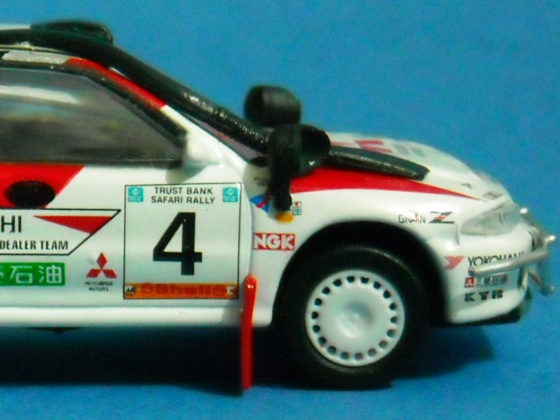
CM's Mitsubishi Lancer Evolution 1994 Safari Rally 1:64 Chase car

This is CM's Mitsubishi Lancer Evolution 1994 Safari Rally in 1:64 scale, chase car.