A Minichamps Mercedes Benz C-Class, at the 2006 Deutsche Tourenwagen Masters (DTM) driven by Daniel La Rosa, in 1:43 scale.
From Wikipedia:
The Mercedes-Benz C-Class is a compact executive car produced by the
Mercedes-Benz division of Daimler AG. First introduced in 1993 as a replacement
for the 190 range, the C-Class was nicknamed the "Baby Benz" as it was the
smallest model in the marque's lineup, until the 1997 arrival of the A-Class.
The C-Class is built at Mercedes-Benz factories in Sindelfingen and Bremen,
Germany, in Santiago Tianguistenco, Mexico by Mercedes-Benz-Xicotencatl as well
as in Mercedes's factories in Brazil and DaimlerChrysler's South African
factory in East London. The very first W202 C-Class sedan was produced on June
1, 1993, and the second generation W203 C-Class rolled off the assembly line on
July 18, 2000. The third generation W204 C-Class was launched in 2007. The
C-Class is the entry-level offering in Mercedes-Benz's United States lineup.
The C-Class platform has been used for several coupes, including the CLC-Class
(and its predecessor, the C-Class Sportcoupe) and the E-class Coupe (and its
predecessor, the CLK-Class).
Daniel la Rosa (born October 10, 1985 in Hanau, Germany) is a German racing
driver. He has raced in the Formula Renault 3.5 Series and also in the Deutsche
Tourenwagen Masters. He is most well known for getting a podium in the opening
round of the 2007 DTM season at the Hockenheimring. He also was a test driver in
the 2008 Superleague Formula season. He doesn't race full-time in motorsport
anymore.
Popular Posts
-
From the write ups of the book of the parish, "The early beginnings of the parish of Nuestra Senora dela Purification in Binmaley can ...
-
An Autoart Millenium 1970 Mercedes Benz 300 SEL, in 1:18 scale. Some facts from Wikipedia: The Mercedes-Benz 300 SEL 6.3 started out as...
-
Ixo maserati quattroporte italian presidential car, w/ Vanguards Range Rover and Kinsmart Lincoln navigator. From Wikipedia: The M...
-
A Kyosho Lancia Stratos HF 1977 Monte Carlo Winner, driven by S. Munari/ S. Maiga, 1:18 scale. Kyosho made a very impressive details on thi...
-
The 2010 Manila Auto Salon Car Show is currently being held here in the Philippines, from November 18 to 21, 2010. Diecast Car Collectors o...
-
Autoart Mitsubishi Lancer Evo IX, 1:18 scale. In one of my favorite colors in automobiles, yellow. Thanks for viewing. Some fact...
-
A Tomica Event Model Mitsubishi Lancer Evolution X, in 1:61 scale.
-
A Vitesse Mitsubishi Carisma MSX in 1:43 scale, color "flame red". From Wikipedia: The Mitsubishi Carisma is a large famil...
-
This is CM's Mitsubishi Lancer Evolution 1994 Safari Rally in 1:64 scale, chase car.
Sunday, December 19, 2010
Sunday, December 12, 2010
Vitesse Mercedes Benz 600 Pullman 1965, six door, 1:43 scale
A Vitesse 1965 Mercedes Benz 600 Pullman, six door, in 1:43 scale.
Cadillac Fleetwood 75, the stretched Lehmann-Peterson Lincoln and the Crown
Imperial Ghia. Generally, the long wheel base 600 was intended to be
chauffeur-driven; many of those 600s featured a central divider incorporating a
power window between the front and rear compartments. The short wheel base 600
was designed to be owner driven.
Production began in 1964 and most 600 variants were built until 1972. The oil
crisis, as well as the introduction of new S-Class models, slowed demand. Modest
production continued until 1981. During this time, 2,677 vehicles were made.
The 600 featured many luxuries, including a complex hydraulic system which
powered everything with a pressure of 150 bar, from the windows and seats to the
automatically closing doors, sun roof and trunk.
Apart from the Pope and governments, famous owners of the 600 include
celebrities such as Coco Chanel, Hugh Hefner, Elizabeth Taylor, John Lennon,
George Harrison, Jay Kay, Aristotle Onassis, Jack Nicholson, Simon Spies, Bob
Jane, Frank Packer, Elvis Presley, Rowan Atkinson, and Jeremy Clarkson,
Communist leaders include Nicolae Ceauşescu, Josip Broz-Tito, Fidel Castro, Pol
Pot, Enver Hoxha, Leonid Brezhnev, Kim Il-sung, Kim Jong-Il also owns a
landaulet (both seen in the 65th anniversary parade in Pyongyang on October 10,
2010) and religious leader Guru Maharaj Ji. African revolutionaries Idi Amin
Dada, Jomo Kenyatta and the former Philippine President Ferdinand Marcos had
four 600s including a Landaulet, a 1981 bulletproof and a six-door
version.
Some facts fromWikipedia:
The Mercedes-Benz 600 is a large luxury automobile. When introduced in
September, 1963, it had very few competitors, these being Rolls-Royce, the Cadillac Fleetwood 75, the stretched Lehmann-Peterson Lincoln and the Crown
Imperial Ghia. Generally, the long wheel base 600 was intended to be
chauffeur-driven; many of those 600s featured a central divider incorporating a
power window between the front and rear compartments. The short wheel base 600
was designed to be owner driven.
Production began in 1964 and most 600 variants were built until 1972. The oil
crisis, as well as the introduction of new S-Class models, slowed demand. Modest
production continued until 1981. During this time, 2,677 vehicles were made.
The 600 featured many luxuries, including a complex hydraulic system which
powered everything with a pressure of 150 bar, from the windows and seats to the
automatically closing doors, sun roof and trunk.
Apart from the Pope and governments, famous owners of the 600 include
celebrities such as Coco Chanel, Hugh Hefner, Elizabeth Taylor, John Lennon,
George Harrison, Jay Kay, Aristotle Onassis, Jack Nicholson, Simon Spies, Bob
Jane, Frank Packer, Elvis Presley, Rowan Atkinson, and Jeremy Clarkson,
Communist leaders include Nicolae Ceauşescu, Josip Broz-Tito, Fidel Castro, Pol
Pot, Enver Hoxha, Leonid Brezhnev, Kim Il-sung, Kim Jong-Il also owns a
landaulet (both seen in the 65th anniversary parade in Pyongyang on October 10,
2010) and religious leader Guru Maharaj Ji. African revolutionaries Idi Amin
Dada, Jomo Kenyatta and the former Philippine President Ferdinand Marcos had
four 600s including a Landaulet, a 1981 bulletproof and a six-door
version.
Labels:
Mercedes Benz 600,
Vitesse
Vitesse Mitsubishi Carisma MSX in 1:43 scale
A Vitesse Mitsubishi Carisma MSX in 1:43 scale, color "flame red".
From Wikipedia:
The Mitsubishi Carisma is a large family car produced for the European market
by Mitsubishi Motors from 1995 to 2004. The model name was derived from a
combination of the English car and the Greek kharisma, meaning "divine gift".
It was co-developed with Volvo, sharing its chassis with the first generation of
the Volvo S40, and built at the NedCar factory in Born, Netherlands, which the
two companies co-owned at the time. Over 350,000 were built during its
production run.
Available as a 4-door saloon or a 5-door hatchback, it featured gasoline engines
from 1.3 L (introduced later in life) to 1.8 L, a 1.8 L gasoline direct
injection engine, and 90 hp (67 kW) Renault F8Q 1.9 L turbodiesel powerplants
sourced from Renault, later with the 100 hp (70 kW) 1.9 DI-D common rail diesel
F9Q engine, the same as used in both Volvo and Renault cars.
In spite of its name, the Carisma had a fairly neutral design as a result of
being Mitsubishi's first attempt to target the traditionally conservative
European company car market. Even when receiving a midlife facelift in 2001
that characteristic was not improved. The car was placed between the Lancer and
the Galant, although after production ended, the Lancer took its place in
Mitsubishi's European range.
In several markets where the Lancer was not available, the Evolution version was
rebadged as a Mitsubishi Carisma GT.
The chassis was also used by Proton to develop the Proton Waja.
From Wikipedia:
The Mitsubishi Carisma is a large family car produced for the European market
by Mitsubishi Motors from 1995 to 2004. The model name was derived from a
combination of the English car and the Greek kharisma, meaning "divine gift".
It was co-developed with Volvo, sharing its chassis with the first generation of
the Volvo S40, and built at the NedCar factory in Born, Netherlands, which the
two companies co-owned at the time. Over 350,000 were built during its
production run.
Available as a 4-door saloon or a 5-door hatchback, it featured gasoline engines
from 1.3 L (introduced later in life) to 1.8 L, a 1.8 L gasoline direct
injection engine, and 90 hp (67 kW) Renault F8Q 1.9 L turbodiesel powerplants
sourced from Renault, later with the 100 hp (70 kW) 1.9 DI-D common rail diesel
F9Q engine, the same as used in both Volvo and Renault cars.
In spite of its name, the Carisma had a fairly neutral design as a result of
being Mitsubishi's first attempt to target the traditionally conservative
European company car market. Even when receiving a midlife facelift in 2001
that characteristic was not improved. The car was placed between the Lancer and
the Galant, although after production ended, the Lancer took its place in
Mitsubishi's European range.
In several markets where the Lancer was not available, the Evolution version was
rebadged as a Mitsubishi Carisma GT.
The chassis was also used by Proton to develop the Proton Waja.
Labels:
Mitsubishi Carisma MSX,
Vitesse
Autoart Volkswagen New Beetle RSi in 1:43 scale
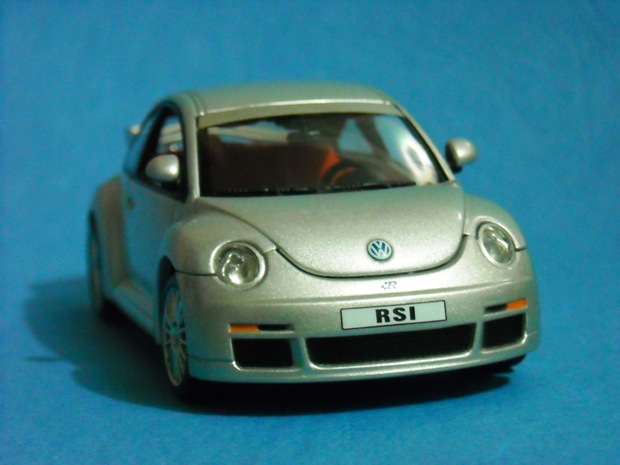
An Autoart Volkswagen New Beetle RSi in 1:43 scale.
From Wikipedia:
The Volkswagen New Beetle is a small family car, introduced by Volkswagen in
1998, drawing heavy inspiration from the exterior design of the original Beetle.
Unlike the original Beetle, the New Beetle has its engine in the front driving
the front wheels and luggage storage in the rear. In May 2010, Volkswagen
announced that production of the current body of the New Beetle will cease in
2011. A redesigned model will replace it.
The VW RSi is a limited (250 units) version of New Beetle. It included
a 225 hp 3.2 litre VR6 engine, a 6-speed gearbox, and Volkswagen's four-wheel
drive system 4motion, Remus twin-pipe exhaust. It was rumoured Porsche tuned the
suspension but this was carried out in-house at VW Individual. The suspension
was greatly altered at the rear, with geometry more geared to the race track and
a rear cross brace behind the rear seats, 80 mm (3.1 in) wider fenders, unique
front and rear bumpers, a rear diffuser, large rear wing, and 18x9 OZ
Superturismo wheels with 235/40ZR-18 tyres. Inside, it was trimmed in carbon
fiber, billet aluminum, and bright orange leather. The front seats were Recaro
racing buckets. Notable disadvantages found were loud cabin noise and low rear
tire life.
From Wikipedia:
The Volkswagen New Beetle is a small family car, introduced by Volkswagen in
1998, drawing heavy inspiration from the exterior design of the original Beetle.
Unlike the original Beetle, the New Beetle has its engine in the front driving
the front wheels and luggage storage in the rear. In May 2010, Volkswagen
announced that production of the current body of the New Beetle will cease in
2011. A redesigned model will replace it.
The VW RSi is a limited (250 units) version of New Beetle. It included
a 225 hp 3.2 litre VR6 engine, a 6-speed gearbox, and Volkswagen's four-wheel
drive system 4motion, Remus twin-pipe exhaust. It was rumoured Porsche tuned the
suspension but this was carried out in-house at VW Individual. The suspension
was greatly altered at the rear, with geometry more geared to the race track and
a rear cross brace behind the rear seats, 80 mm (3.1 in) wider fenders, unique
front and rear bumpers, a rear diffuser, large rear wing, and 18x9 OZ
Superturismo wheels with 235/40ZR-18 tyres. Inside, it was trimmed in carbon
fiber, billet aluminum, and bright orange leather. The front seats were Recaro
racing buckets. Notable disadvantages found were loud cabin noise and low rear
tire life.
Labels:
Autoart,
Volkswagen New Beetle
Sunday, December 5, 2010
Autoart Millenium Audi Sport Quattro Rally de Monte Carlo 1985, S. Blomqvist / B. Cederberg in 1:18 scale
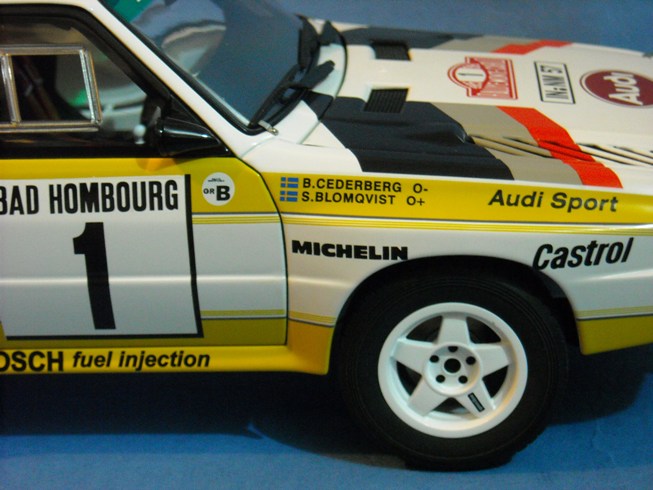
An Autoart Millenium Audi Sport Quattro, Rally de Monte Carlo 1985, driven by: S. Blomqvist/ B. Cederberg, in 1:18 scale.
Geneva Motor Show on 3 March.
four-wheel drive version of an Audi model. To avoid confusion, the original
Quattro model is also commonly referred to as the Ur-Quattro - the "Ur-" (German
for "primordial" or "ancestral") is an augmentative prefix, in this case meaning
"original", and is also applied to the first generation Audi S4 and Audi S6
models, as in "Ur-S4" and "Ur-S6".
The Audi Quattro was the first rally car to take advantage of the then-recently
changed rules which allowed the use of four-wheel drive in competition racing.
It won competition after competition for the next two years.[1] To commemorate
the success of the original vehicle, all subsequent Audis with their trademark
quattro four wheel drive system were badged "quattro" with a lower case "q". The
original car with the upper case "Q" in the Quattro name is a collector's piece.
The Audi Quattro shared many components and the core of its body style with the
Audi Coupé, which was a member of the Audi 80 (B2) model range.[1] It was
internally designated Typ 85, a type number it shared with the Audi Coupé GT,
Audi Coupé quattro and Audi 4000CS quattro. Its characteristic flared
wheelarches were styled by Martin Smith. The Audi Quattro also had independent
rear suspension and independent front suspension.
Driven by Stig Blomqvist, Mikkola and Walter Röhrl, the A2 evolution won a total
of eight world rallies; three in 1983 and five in 1984.
From Wikipedia:
The Audi Quattro is a road and rally car, produced by the German automobile
manufacturer Audi, part of the Volkswagen Group. It was first shown at the 1980 Geneva Motor Show on 3 March.
The word quattro is derived from the Italian word for "four". The name has also
been used by Audi to refer to the quattro four-wheel drive system, or any four-wheel drive version of an Audi model. To avoid confusion, the original
Quattro model is also commonly referred to as the Ur-Quattro - the "Ur-" (German
for "primordial" or "ancestral") is an augmentative prefix, in this case meaning
"original", and is also applied to the first generation Audi S4 and Audi S6
models, as in "Ur-S4" and "Ur-S6".
The Audi Quattro was the first rally car to take advantage of the then-recently
changed rules which allowed the use of four-wheel drive in competition racing.
It won competition after competition for the next two years.[1] To commemorate
the success of the original vehicle, all subsequent Audis with their trademark
quattro four wheel drive system were badged "quattro" with a lower case "q". The
original car with the upper case "Q" in the Quattro name is a collector's piece.
The Audi Quattro shared many components and the core of its body style with the
Audi Coupé, which was a member of the Audi 80 (B2) model range.[1] It was
internally designated Typ 85, a type number it shared with the Audi Coupé GT,
Audi Coupé quattro and Audi 4000CS quattro. Its characteristic flared
wheelarches were styled by Martin Smith. The Audi Quattro also had independent
rear suspension and independent front suspension.
The Quattro A1 debuted at the 1983 season opener Monte Carlo Rally, and went on
to win the Swedish Rally and the Rally Portugal in the hands of Hannu Mikkola. Driven by Stig Blomqvist, Mikkola and Walter Röhrl, the A2 evolution won a total
of eight world rallies; three in 1983 and five in 1984.
Labels:
Audi Sport Quattro,
Autoart Millenium
Disney Store Red Chase, Cars, Radiator Springs
A Disney Store Red chase car, radiator springs, from the Disney movie Cars. Red is 1960s style fire truck, which closely resembles a mid-1960s Pirsch pumper or American LaFrance model. Joe Ranft played Red, who died in 2005 in a car crash.
Labels:
Cars,
Disnet Store Red Chase
Norev Volkswagen Iltis 1980 Dakar Rally, F. Kottulinsky / G. Loffelmann 1:43 scale VW
A Norev Volkswagen Iltis 1980 Dakar Rally, driven by: Freddy Kottulinsky/ Gerd Loffelmann in 1:43 scale. Great looking Europa jeep.
German military and under licence by Bombardier for the Canadian Forces and
Belgian Army. Although the two vehicles were briefly offered simultaneously, the
Type 183 effectively replaced the Type 181.
The German military had been part of a cooperative effort beginning in the late
1960s to create what was dubbed the Europa Jeep, an amphibious four wheel drive
vehicle that could replace the small all-terrain transport vehicles being used
by several of the participating governments. With development taking longer than
expected, the German military requested that something inexpensive be built in
small quantities to fill their need for additional small transport vehicles
while the Europa Jeep project was still undergoing design research.
Volkswagen responded to the request, designing an updated version of their
Kübelwagen and designating it the Type 181. But by 1976 the Europa Jeep project
had fallen apart completely, the victim of skyrocketing costs and a difficult
development. Needing a suitable four wheel drive vehicle to take over the spots
that had been designated for the Europa Jeep, the German government issued
requests to several manufacturers to design and build prototype vehicles to be
considered for military use.
Dakar Rally winner of 1980The vehicle featured a variation of the Munga's
platform with newly modified suspension components, a four wheel drive system
based around components from the Audi 100 and a 1.7 litre four cylinder Audi
engine producing 75 horsepower. The design of this four wheel drive system
provided the basis for Audi's Quattro system, which debuted four years later in
1980 on the original Audi Quattro. Earlier that year, Freddy Kottulinsky and
Gerd Löffelmann had won the Paris-Dakar Rally in an Audi-prepared Iltis.
The Iltis, as VW was now calling it, passed the German government's tests with
ease, and was chosen over the equally competent but more expensive Mercedes-Benz
G-Wagen. Production began in the summer of 1978 and the first 200 units were
delivered in November; by late 1979 approximately 2,000 units had been delivered
with 310 units sent to the Luftwaffe and 20 sent to the German Navy. Although
most of the units produced were four-doored with open tops, ambulance,
anti-tank, artillery survey, command and field communications units with varying
bodystyles were produced in small numbers. A civilian model was also offered in
Germany, but found even fewer takers than the 181 had, largely due to price.
From Wikipedia:
The Volkswagen Type 183, more commonly known as the Iltis (German for the
European Polecat), is a military vehicle built by Volkswagen for use by the German military and under licence by Bombardier for the Canadian Forces and
Belgian Army. Although the two vehicles were briefly offered simultaneously, the
Type 183 effectively replaced the Type 181.
The German military had been part of a cooperative effort beginning in the late
1960s to create what was dubbed the Europa Jeep, an amphibious four wheel drive
vehicle that could replace the small all-terrain transport vehicles being used
by several of the participating governments. With development taking longer than
expected, the German military requested that something inexpensive be built in
small quantities to fill their need for additional small transport vehicles
while the Europa Jeep project was still undergoing design research.
Volkswagen responded to the request, designing an updated version of their
Kübelwagen and designating it the Type 181. But by 1976 the Europa Jeep project
had fallen apart completely, the victim of skyrocketing costs and a difficult
development. Needing a suitable four wheel drive vehicle to take over the spots
that had been designated for the Europa Jeep, the German government issued
requests to several manufacturers to design and build prototype vehicles to be
considered for military use.
Dakar Rally winner of 1980The vehicle featured a variation of the Munga's
platform with newly modified suspension components, a four wheel drive system
based around components from the Audi 100 and a 1.7 litre four cylinder Audi
engine producing 75 horsepower. The design of this four wheel drive system
provided the basis for Audi's Quattro system, which debuted four years later in
1980 on the original Audi Quattro. Earlier that year, Freddy Kottulinsky and
Gerd Löffelmann had won the Paris-Dakar Rally in an Audi-prepared Iltis.
The Iltis, as VW was now calling it, passed the German government's tests with
ease, and was chosen over the equally competent but more expensive Mercedes-Benz
G-Wagen. Production began in the summer of 1978 and the first 200 units were
delivered in November; by late 1979 approximately 2,000 units had been delivered
with 310 units sent to the Luftwaffe and 20 sent to the German Navy. Although
most of the units produced were four-doored with open tops, ambulance,
anti-tank, artillery survey, command and field communications units with varying
bodystyles were produced in small numbers. A civilian model was also offered in
Germany, but found even fewer takers than the 181 had, largely due to price.
Labels:
Norev,
Volkswagen Iltis
Subscribe to:
Posts (Atom)